By Ryan Marks
Published Tuesday October 20, 2026
You own your home. It has gone up in value. Your first mortgage has a rate you never want to give up. So you walk into your bank, ask about a home equity line of credit, and hear the same thing a lot of business owners hear.
Sorry, you don’t qualify.
If you are self employed, that answer usually has nothing to do with how much money your business makes. It has to do with how the bank measures it.
Why the bank says no
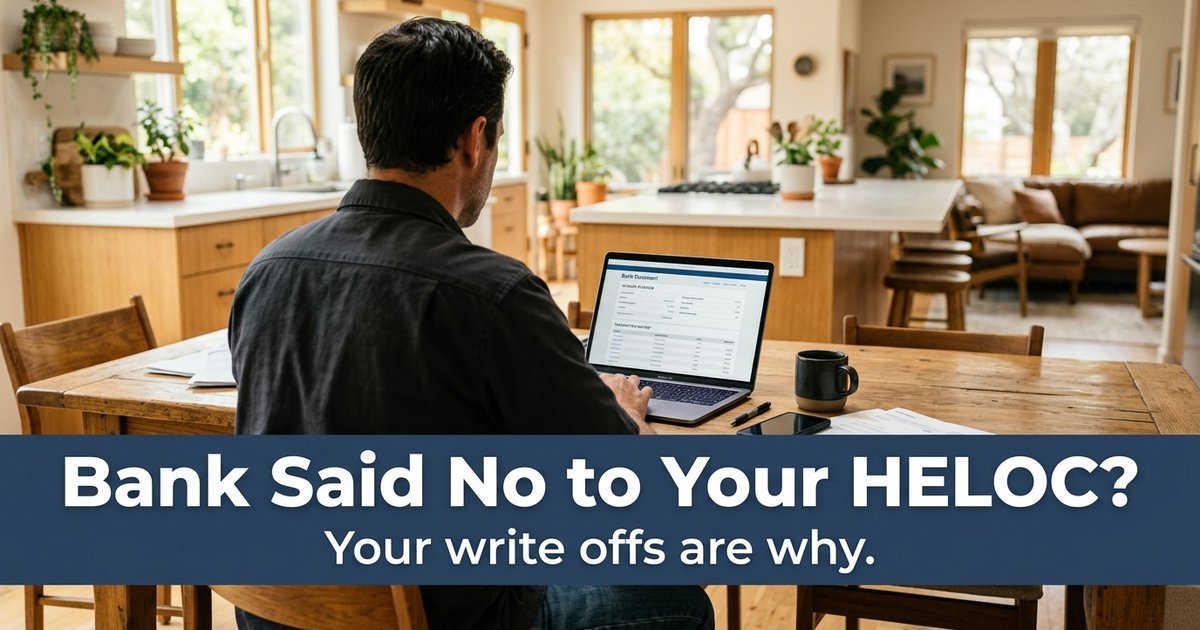
A traditional bank or lender offering a HELOC qualifies you off your tax returns. They use your adjusted income after every deduction and write off you took. That number is then used to figure your debt to income ratio, which is your monthly debts divided by your monthly income.
The same write offs that lower your tax bill also lower your income on paper. A business that runs healthy deposits through the bank every month can show a small number on the return, and the bank only sees the small number.
On top of that, banks often hold HELOCs to a tighter debt to income limit than a regular first mortgage, with very little room for exceptions. Lower qualifying income plus a stricter limit is why so many owners with real equity get turned down.
A different way to show your income
In the non QM space, a HELOC can be qualified with other documentation instead of tax returns. The most common is 12 or 24 months of bank statements, the same idea behind a bank statement HELOC.
We average the deposits your business earned over that period, set aside a portion for business expenses, and use what is left as your qualifying income. It is the same method we use for a bank statement loan when you buy a home. If your CPA or tax preparer can confirm your actual expense ratio, that can be used as well.
You still have to qualify. There is still a debt to income ratio, and your credit still matters. The difference is that your income reflects what actually hits your account, so the ratio usually looks very different. Non QM HELOCs also tend to allow more room on debt to income and on how much of your equity you can reach than a typical bank line. Every lender sets its own limits, so we look at your numbers before promising anything.
People often expect a big rate penalty for skipping tax returns. In my experience the pricing is usually close to a standard HELOC, because the rate is driven mostly by your credit, how much equity you keep, the property type, and whether you live there. Your rate will depend on your file.
Keep your low first mortgage rate
This is the part I care most about. If you want the bigger picture on using a HELOC for debt, see HELOC debt consolidation. If you cannot get a HELOC, the other common way to reach your equity is a cash out refinance. That means replacing your first mortgage, possibly losing the low rate you have now, and cash out pricing on a first mortgage is typically higher than a plain rate and term refinance.
A HELOC sits behind your first mortgage as a second lien. Your first loan, and its rate, stay exactly where they are.
How a HELOC works day to day
A HELOC is a line of credit, a lot like a credit card secured by your home.
- If the line is open and your balance is zero, you have no payment.
- When you draw on it, your payment is figured on what you actually owe that month.
- During the draw period the minimum payment is often interest only, so the balance does not go down unless you pay extra. You can pay it down any time.
- Most HELOCs have a variable rate, so the rate and the payment can go up as well as down.
Where self employed owners use it
These are the uses I hear about most often.
Slow season cushion. If your business is seasonal, or you hit a slow stretch, you can draw on the line instead of taking a personal or business loan, then pay it back to zero when revenue comes back.
Waiting on an insurance check. A leak or storm damage can’t wait for the claim to pay out, especially when mold is a risk. A line lets you make the repair now and pay it back when the insurance money arrives.
Home improvements, paying down higher cost debt, or a down payment on another property. All common, and all work best with a clear plan to pay the line back.
Rental properties. If the equity is in an investment property, a bank statement HELOC may work, and there are also fixed second mortgages that qualify on the property’s rent instead of your personal income. That is a separate conversation, and I am happy to walk through it.
What to keep in mind
Your home secures a HELOC. The Consumer Financial Protection Bureau is clear that if you cannot repay, you could lose your home, and that payments can rise sharply once the draw period ends and repayment begins. A variable rate can increase. Approval is never guaranteed, and terms differ from lender to lender. Use the line for things that leave you in a better spot, and know how you will pay it back before you draw.
Bottom line
A no from the bank on a HELOC is often a no to your tax return, not to your finances. If you are self employed, have equity, and want to keep the rate on your first mortgage, a bank statement HELOC is worth a look.
If you want to see how your deposits would qualify, reach out at seimortgage.com and we can go over the best approach for your situation.
Ryan Marks, Senior Loan Officer, NMLS 519138, Everyday Lending Group
Frequently asked questions
Can I get a HELOC if I’m self employed and my tax returns show low income?
Possibly. Banks usually qualify you on taxable income after write offs. A non QM HELOC can use 12 or 24 months of bank statements instead, so your income reflects your actual deposits. You still need to qualify on credit, equity, and debt to income.
Will a HELOC change my first mortgage?
No. A HELOC is a second lien that sits behind your first mortgage. Your first loan and its rate stay the same.
Is a bank statement HELOC rate much higher?
Not always. Pricing is driven mostly by credit, equity, property type, and occupancy. Your actual rate depends on your file and the lender.
What are the risks?
Your home secures the line, most HELOCs have variable rates, and payments can rise when repayment starts. If you cannot repay, you could lose your home.
Watch the full video: Tap Your Property Equity Without Refinancing Your First Mortgage (Non QM HELOC). Source for risk language: CFPB, What is a HELOC.